Wednesday, May 8, 2024

A00017 - Henry Martin Tupper (Class of 1859), Founder of Shaw University

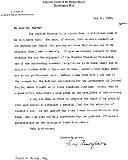
 Henry Martin Tupper (April 11, 1831 – November 12, 1893) was an American Baptist minister who founded Shaw University in Raleigh, North Carolina. Beginning with bible and literacy classes in December 1865, it was the second university established for African Americans following the end of the civil war, and the second oldest historically black college and university (HBCU) in the Southern United States,[1][2] as well as one of the oldest co-educational universities in the country. When the institute moved into a new building in 1871, it was renamed as Shaw Collegiate Institute in honor of a major donor. Tupper served as the University's first president from its founding until his death in 1893.

Early life and military career[edit]

Henry Martin Tupper was born on April 11, 1831, to Earl and Permellia Norris Tupper and raised on a farm in Monson, Massachusetts. He was the eldest of nine children. His grandfather, Ezra Tupper, and great-grandfather, William Tupper, had both fought for the colonies in the American Revolutionary War. His paternal ancestry has been linked to a family of prominent Lutheran dissenters who left Germany and settled in England during the reign of Henry VIII. He was a distant relative of Martin Farquhar Tupper, an English poet of the 19th century. Clergyman Thomas Tupper, an ancestor of Henry Martin Tupper, emigrated from England to Barbados in the early 17th century. He later helped found the town of Sandwich, Massachusetts.[3][4][5]

Neither of his parents were practicing Christians nor did Martin attend church as a child. He received little formal education until he turned eighteen, when he enrolled in Monson Academy. He converted to Christianity while at the Academy. In order to fund his continuing education, he took a job as a school teacher in New Jersey, where he was baptised in a nearby Baptist church. Later he joined a congregation in Wales, Massachusetts, near his hometown of Monson.[3]

Tupper attended Amherst College and graduated in 1859. He received his divinity degree from Newton Theological Institute in 1862. While at school, he organized bible studies for African-American youth. He also worked as a missionary among recent immigrants in Boston as part of his training. He had planned to serve as a missionary to Africa, however the Civil War intervened. Shortly after being ordained as a minister, he enlisted in the Union Army. Though his education would have qualified him for a military commission, there were no openings in the officer corps, so he enlisted as a soldier.[3]

Tupper was assigned to the Army of the PotomacNinth Corps, under the command of Ambrose Burnside. He participated in the Battle of Fredericksburg. He was transferred to General Sherman's Fifteenth Corps in time for the Vicksburg Campaign. He was injured at the Battle of Jackson.[3]

Though Tupper was not an officer, he frequently served as a chaplain, ministering to sick and injured soldiers, and organizing prayer meetings and bible studies among soldiers. While in the army, he became acquainted with the plight of African-American slaves. This inspired his later work.[3]

Marriage and family[edit]

On January 25, 1864, he married Sarah Baker Leonard of StaffordConnecticut. She later joined him in his work, helping teach freedwomen as he taught the men. They had two children, Elizabeth Caroline and Edward Leonard Tupper. Sarah's older brother Judson Wade Leonard, a successful businessman in woolen textiles, helped support Shaw University financially. The medical school was named for him.[4]

Founder and president of Shaw University[edit]

After the Civil War, Tupper was commissioned by the Home Mission Society to act as a missionary to freed slaves in the American South. Discharged from the Union Army on July 14, 1865, he and his wife Sarah departed for RaleighNorth Carolina, on October 1 to begin his work. Traveling via train through PortsmouthVirginia, they had delays due to extensive damage to the rail network caused by the Civil War; they arrived in Raleigh on October 10. The Tuppers began working among the freedmen. He procured food and clothing from the Freedman's Bureau to help support the many homeless black men in Raleigh.[3][6]

On December 1, 1865, Tupper began teaching bible study classes to freedmen in the Guion Hotel (located where the North Carolina Museum of History is now located). This first bible class marks the traditional foundation date of Shaw University. He used the class as an opportunity to teach the freedmen to read and write, encouraging them to become Baptist ministers, and start their own congregations. In March 1866, Sarah Tupper began teaching freedwomen in similar classes.[3][6][7]

Having outgrown his temporary location at the Guion Hotel, Tupper purchased a plot of land, using $500 saved from his military service. On the plot, located at the corner of Blount and Cabarrus streets in Raleigh, he constructed a two-story timber building to serve as both a school and church. He named this the Raleigh Institute; it was the first permanent home what would develop as Shaw University. The Home Mission Society and the Freedman's Bureau jointly provided funding for the Institute.[6][7]

As the school grew, Tupper searched for more space. Nearby to the south was the estate of Paul Barringer, the patriarch of a prominent North Carolina political dynasty. When the land came up for sale, Martin Tupper raised $13,000 for its purchase, mostly from private donors solicited personally by Tupper. The largest single donor was Elijah Shaw, a resident of Wales, Massachusetts, who donated $5,000.

In his honor, the first building on the new campus was named Shaw Hall, and the school was renamed the Shaw Collegiate Institute. Tupper and his students and faculty moved into their new location in 1871. Expansion proceeded quickly, as the first men's dormitory opened in 1872, and the first women's dormitory, Estey Hall (named for another Northern benefactor, Jacob Estey of BrattleboroVermont), opened in 1874.

Under Tupper's leadership, the school became chartered by the state as a university in 1875. It added a medical and pharmacy program (Leonard Medical School) in 1881, and a law program in 1888. Each of these programs were the first of their kind for African-American students.[3][6][8] Note: Howard University, a historically black university, dates its law school to 1869, when a law department was established by John Mercer Langston.[9] Along with two students, Nicholas Franklin Roberts and Edward Hart Lipscomb, Tupper was an editor of the quarterly journal, African Expositor, founded in 1878.[10]

Tupper's role as the founder of the first university dedicated to educating freedmen attracted opposition. During the Reconstruction era, his home was burned to the ground by the Ku Klux Klan. He and his wife fled and hid in a nearby cornfield.[3] In 1870 the trustees of the local Second Baptist Church of Raleigh sued Tupper on charges of defrauding its members in relation to his fundraising for Shaw College. The suit was settled in his favor in 1875.[6]

Death[edit]

Tupper died on November 12, 1893, following a prolonged illness. His funeral was reportedly one of the most attended in the history of Raleigh to that time. Tupper was buried on the campus in front of Shaw Hall.[3][6]

A00016 - Robert Purvis, African American Abolitionist Who Most Likely Attended Amherst Academy

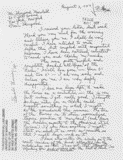
 Robert Purvis (August 4, 1810 – April 15, 1898) was an American abolitionist in the United States. He was born in Charleston, South Carolina, and was likely educated at Amherst Academy, a secondary school in Amherst, Massachusetts. He spent most of his life in Philadelphia, Pennsylvania. In 1833 he helped found the American Anti-Slavery Society and the Library Company of Colored People. From 1845 to 1850 he served as president of the Pennsylvania Anti-Slavery Society and also traveled to Britain to gain support for the movement.

Of mixed race, Purvis and his brothers were three-quarters European by ancestry and inherited considerable wealth from their native British father after his death in 1826. Purvis's parents had lived in a common law marriage, prevented from marrying because his mother was a mixed race free woman of color, of Sub-saharan African, Jewish, and Moroccan descent. The sons chose to identify with the black community and used their education and wealth to support abolition of slavery and anti-slavery activities, as well as projects in education to help the advance of African Americans.

Early life[edit]

Purvis was born in 1810 in Charleston, South Carolina. His maternal grandparents were Dido Badaraka, a former enslaved woman, and Baron Judah, a Jewish American native of Charleston. His mother Harriet Judah was born a free woman of color. Purvis's father was an immigrant from Great Britain.

As an adult, Purvis told a reporter about his family. His maternal grandmother, Badaraka, was kidnapped at age 12 from Morocco where she was already a slave, she was then transported to South Carolina on a slave ship, and sold as a slave in India. He described her as dark-skinned with tightly curled hair, she was most likely of Sub-Saharan African descent as evidenced by her name and her physical description. She was freed at age 19 by her master's will.[2][3] Harriet's father was Baron Judah, born in Charleston of German Jewish and Spanish-Portuguese Jewish descent.[1] Baron was the third of ten children born to Hillel Judah, a German Jewish immigrant, and Charleston native Abigail Seixas, his Spanish-Portuguese Jewish wife.

Purvis told the reporter that his grandparents Badaraka and Judah had married. This claim has been questioned by 21st-century biographers, given the social prominence of the Judah family in Charleston. Judah's parents owned slaves. In any case, Badaraka and Judah had a relationship for several years, and had two children together, Harriet and her brother. In 1790, Judah broke off his relationship with Badaraka when he moved with his parents from Charleston to Savannah, Georgia. In 1791 he moved to Richmond, Virginia. There he married a Jewish white woman and had four children with her.[4]

William Purvis was from Northumberland. His father died while he was a child, and his mother moved to Edinburgh for her sons' education. He immigrated to the United States as a young man with some of his brothers to make their fortunes. William became a wealthy cotton salesman in Charleston and was a naturalized United States citizen.[1][5]

William Purvis and Harriet Judah lived together as husband and wife, but racial law prevented their marriage. The couple had three sons: William, born in 1806; Robert, born in 1810; and Joseph, born in 1812.[5] In 1819 the family moved north to Philadelphia, Pennsylvania, where the boys attended the Pennsylvania Abolitionist Society's Clarkson School. William intended to consolidate his business affairs and return with his family to Britain, where he thought his sons would have better opportunities. He died in 1826 before they could move.[citation needed]

William Purvis had intended his sons to be educated as gentlemen, and Robert and Joseph Purvis likely attended Amherst Academy, a secondary school in Amherst, Massachusetts. There is no evidence that either Robert or Joseph Purvis attended Amherst College, a common misconception.[6] (Amherst College catalogs from the 1820s do not list them as enrolled.) The brothers returned to Philadelphia, where their family was among the black elite. After their father died, Purvis and his two brothers were to share an estate worth $250,000. In 1828 the oldest brother William died of tuberculosis. Robert and Joseph inherited increased shares of the estate; they used their wealth to support their political activism and public service.[7]

In 1832, Purvis married Harriet Davy Forten, a woman of color and the daughter of wealthy sailmaker James Forten and his wife Charlotte, both prominent abolitionists and leaders in Philadelphia. Like her parents and siblings, Harriet Forten Purvis was active in anti-slavery groups in the city, including the interracial Philadelphia Female Anti-Slavery Society.[8]

The Purvises had eight children, including son Charles Burleigh Purvis (1841-1926). He became a surgeon and professor for 30 years in the medical school at Howard University. In addition, the couple raised Harriet's niece, Charlotte Forten Grimké, after her mother died. In her later life, Harriet Forten Purvis lectured publicly against segregation and for expanded suffrage for all citizens.[8]

After Harriet died, Purvis married Tacie Townsend, who was of European descent.[3] She was from Byberry Township (now Northeast Philadelphia), where Purvis had moved after the 3-day riots threatened his safety. As a public figure, he was criticized for this marriage by both whites and blacks who cared about the color line.[citation needed]

In 1833, Purvis helped abolitionist William Lloyd Garrison establish the American Anti-Slavery Society in Philadelphia and signed its "Declaration of Sentiments". Living for nearly the rest of the 19th century, Purvis was the last surviving member of the society.[1] That same year, he helped establish the Library Company of Colored People, modeled after the Library Company of Philadelphia, a subscription organization. With Garrison's support, in 1834, Purvis traveled to Britain to meet leading abolitionists.[9]

In 1838, he drafted the "Appeal of Forty Thousand Citizens Threatened with Disfranchisement",[10] which urged the repeal of a new state constitutional amendment disfranchising free African Americans. There were widespread tensions and fears among whites following Nat Turner's slave rebellion of 1831 in Virginia. Although Pennsylvania was a free state that had abolished slavery, state legislators persisted in passing this amendment to restrict free blacks' political rights. Free men of color in Pennsylvania did not regain suffrage until after the ratification of the Fifteenth Amendment in 1870, following the Civil War.[citation needed]

From 1845 to 1850, Purvis served as president of the Pennsylvania Anti-Slavery Society, a biracial organization. As a supporter of the Underground Railroad, Purvis served as chairman of the General Vigilance Committee from 1852 to 1857, which gave direct aid to fugitive slaves. According to his records, Purvis estimated that from 1831 to 1861, he helped one slave per day achieve freedom, aiding a total of more than 9,000 slaves to escape to the North. He used his own house, then located outside the city, in Byberry Township, as a station on the Underground Railroad.[1] One of these slaves was Madison Washington, who Purvis harboured during his escape to Canada.[11] Purvis built Byberry Hall on the edge of the Quaker-owned, Byberry Friends Meeting campus. Byberry Hall, which still stands today, hosted anti-slavery speakers and was across the street from Purvis's home.[12] Among the enslaved Africans he assisted was Thomas J. Dorsey, who became one of three of the top caterers in Philadelphia in the 19th century. Purvis was a friend of both Thomas and his son William Henry Dorsey, who was an artist and collector of Black history. William compiled hundreds of scrapbooks of Black history during the 19th century and built a collection that he laid out in his home in Philadelphia.

Purvis supported many progressive causes in addition to abolition. With Lucretia Mott, he supported women's rights and suffrage. He was a member of the American Equal Rights Association while Mott was president. Purvis also attended the founding meeting of the Pennsylvania Woman Suffrage Association.[1]

He supported temperance and similar social issues. He believed in integrated groups working for greater progress for all. By the end of the Civil War, which gained the emancipation of slaves and suffrage for black men, Purvis had reached his late 50s and became less active in political affairs.[citation needed]

Lombard Street riot[edit]

Irish Catholics, often competitors for the lowest-paying, unskilled and menial jobs, perceived successful African-American residents in the city as flaunting their success. Immigrants expressed their frustrations and jealousy in various attacks on blacks.[13][14]

A three-day race riot began on August 1, 1842. The mostly Irish rioters set fires and attacked firefighters and police as they went, heading for Purvis's home, where they protested outside for forty hours. Purvis and his home were reportedly saved from the Irish mob solely by a Catholic priest's intervention.[15]

Death and legacy[edit]

Neither of Purvis's elder sons survived the American Civil War. Both William P. Purvis (1832–1857) and Robert Purvis (1834–1862) were buried in the Byberry burial ground in northeast Philadelphia.[16] When the burial ground of St. Thomas African Episcopal Church was closed, where his mother had been buried in central Philadelphia, Purvis had her remains transferred to Fair Hill Burial Ground in Philadelphia's Fairhill neighborhood. His wife (1810-1875) and daughter Georgianna (1848-1877) who had died of consumption were buried here, as he was in 1898.[17][18]

His abolitionist efforts are memorialized by the state of Pennsylvania[19] and by the National Park Service.[20]

Wednesday, April 3, 2024

A00015 - Donald Gaines Murray (Class of 1934), Attorney and Plaintiff in the Case of Murray v. Pearson

88888888888888888888888888888888888888888888888888888888888888888888888888888888888

Donald Gaines Murray (May 24, 1914 – April 7, 1986, in Baltimore, Maryland) was an American attorney, the first African-American to enter the University of Maryland School of Law since 1890 as a result of winning the landmark civil rights case Murray v. Pearson in 1935.

Murray was born on May 24, 1914, in Philadelphia, the son of George Lee Murray and Cecilia Lillian Gaines Murray. He graduated from Frederick Douglass High School in 1929. Murray then earned a Bachelor of Arts degree from Amherst College in 1934.[1][2][3]

Murray sought admission to the University of Maryland School of Law on January 24, 1935, but his application was rejected on account of his race and his appeal to the Board of Regents of the university was unsuccessful. The case Murray v. Pearson was initiated by Alpha Phi Alpha fraternity as part of its widening social program; however, Murray was not a member of the fraternity.[4] The fraternity hired Belford Lawson, but by the time the case reached court, Murray was represented by Charles Hamilton Houston and Thurgood Marshall of the Baltimore National Association for the Advancement of Colored People (NAACP). Marshall argued the organization's policy of racial segregation was unconstitutional and argued in principle that "since the State of Maryland had not provided a comparable law school for blacks that Murray should be allowed to attend the white university."[5] and stated

What's at stake here is more than the rights of my client. It's the moral commitment stated in our country's creed.[6]

The Judge issued a writ of mandamus ordering Raymond A. Pearson, president of the university, to admit Murray to the University of Maryland Law School.[5] The ruling was appealed to Maryland's highest court, the Court of Appeals, which affirmed the lower courts' rulings on January 15, 1936.[1][a]

Murray was admitted to the University of Maryland School of Law; however, he was not in a position to pay for tuition and books. Alpha Phi Alpha fraternity paid Murray's tuition and books from the time of his admittance to his graduation from law school.[4]

Murray went on to practice law in Baltimore with the firm of Douglass, Perkins and Murray. He was involved in a number of cases which led to the removal of the color barrier from the University of Maryland graduate schools.

Murray was a member of the Baltimore Urban LeagueAmerican Civil Liberties Union and Kappa Alpha Psi fraternity.[7] He retired around 1971 and died at the age of 72 while in Baltimore's Lutheran Hospital after a lengthy illness.[8]

88888888888888888888888888888888888888888888888888888888888888888888888888888888888

Donald Gaines Murray and the Integration of the University Of Maryland School of Law


Donald Gaines Murray, Sr. (1914 - 1986) was the first African-American to enter the University of Maryland School of Law following the 1890 effort to prevent African-Americans from attending the school (see: "Colored Students Ruled Out"). Murray first sought admission to the University of Maryland School of Law on January 24, 1935, but his application was rejected based on race and his subsequent appeal to the Board of Regents of the university was unsuccessful. Upon this second rejection Murray began to work with lawyers at Washington D.C.'s Howard University to consider possible legal action. According to Juan Williams writing in his 1998 work Thurgood Marshall: American Revolutionary when Thurgood Marshall learned that some other lawyers were considering filing a suit against the State of Maryland and the University:

he [Marshall] got upset and wrote to [Charles Hamilton] Houston that he wanted to be first to file suit. He could not bear to allow any other lawyer to take the lead on this case.

By the time the case reached court, Murray was represented by Charles Hamilton Houston and Thurgood Marshall, with help from Baltimore based attorney Nicholas Gosnell. Marshall argued the organization's policy of racial segregation was unconstitutional and argued in principle that "since the State of Maryland had not provided a comparable law school for blacks that Murray should be allowed to attend the white university." and stated " What's at stake here is more than the rights of my client. It's the moral commitment stated in our country's creed."

Judge Eugene O'Dunne ordered Raymond A. Pearson, president of the university, to admit Murray to the University of Maryland Law School. The ruling was appealed to Maryland's highest court, the Court of Appeals, which affirmed the lower courts' rulings on January 15, 1936.

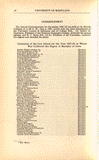
Catalog 1939Murray, who eventually graduated in 1938, [1939 catalog listing Murray's graduation] went on to practice law in Baltimore with the firm of Douglass, Perkins and Murray. He was involved in several subsequent cases which would lead to integration of other professional schools at the University of Maryland.
Murray was a member of the Baltimore Urban League, American Civil Liberties Union and Kappa Alpha Psi Fraternity. He retired in the early 1970s and died at the age of 72. [Murray Obituary]

The Murray case was an involved, far-reaching effort and has been extensively studied by both historians and lawyers. It played an important role in the breaking down of barriers to education at other University of Maryland Schools and helped Thurgood Marshall to develop the arguments that would come to the fore in the Brown v. Board of Education. This site is intended to serve as a starting point for researchers interested in the subject but is not comprehensive.


Legal Materials

Petition for Writ of Mandamus in Baltimore City Circuit Court (1935).

Opinion of the Maryland Court of Appeals in Murray v. Pearson (1936).

Published Opinion: 169 Md. 478 (1936).

Briefs and other records from the Maryland State Archives

Archival Resources

There are a number of archival sources that detail the history of the Murray case. One of the most detailed was assembled by the Maryland State Archives and can be found at "From Segregation to Integration: The Donald Murray Case, 1935-1937." [This site requires a password from the State Archives to access and can be requested directly from the Archives].

Additional archival material may be located in the Papers of the NAACP. Part 3, The Campaign for Educational Equality [series A & B]. These records are available at the Thurgood Marshall Law Library, The University of Maryland School of Law.

The Thurgood Marshall Law Library's African Americans in the Law Special Collection contains several related items:

Murray letter to Justice FrankfurterMurray letter to Thurgood Marshall

Books/Articles

Ball, Howard,
A Defiant life : Thurgood Marshall and the persistence of racism in America. 1st ed.
New York : Crown Publishers, c1998.
428 p., [16] p. of plates : ill. ; 25 cm.
Thurgood Marshall Law Library - KF8745.M34 B35 1998

Before Brown, beyond boundaries : commemorating the 50th anniversary of Brown v. Board of Education: A publication of The Association for the Study of African American Life and History.
Trenton, NJ : Africa World Press, c2004.
205 p. : ill. ; 28 cm. + 1 CD-ROM + 1 poster (56 x 42 cm.)
Thurgood Marshall Law Library - KF4155 .B44 2004

Bland, Randall Walton.
Justice Thurgood Marshall : crusader for liberalism : his judicial biography, 1908-1993.
Bethesda [Md.] : Academica Press, c2001.
364 p. ; 24 cm.
Thurgood Marshall Law Library - KF8745.M34 B547 2001

Davis, Michael D.
Thurgood Marshall : warrior at the bar, rebel on the bench.
New York, N.Y. : Carol Pub. Group, c1992.
400 p. : ill. ; 24 cm.
Thurgood Marshall Law Library - KF8745.M34 D38 1992

McNeil, Genna Rae.
Groundwork: Charles Hamilton Houston and the Struggle for Civil Rights.
Philadelphia University of Pennsylvania Press, 1985.
Electronic Book: Thurgood Marshall Law Library Collection of Civil Rights E-books

Rowan, Carl T.
Dream makers, dream breakers : the world of Justice Thurgood Marshall. 1st ed.
Boston : Little, Brown & Co., c1993.
475 p., 16 plates : ill. ; 24 cm.
Thurgood Marshall Law Library - E185.615 .R65 1993

Smith, J. Clay.
Emancipation : the making of the black lawyer, 1844-1944.
Philadelphia : University of Pennsylvania Press, c1993.
703 p. : ill. ; 24 cm.
Thurgood Marshall Law Library - KF299.A35 S65 1993

Williams, Juan.
Thurgood Marshall : American revolutionary.
New York : Times Books, c1998.
459 p., [16] p. of plates : ill. ; 25 cm.
Thurgood Marshall Law Library - KF8745.M34 W55 1998


The University of Maryland Versus Donald Gaines Murray (Editorial Comment)
The Journal of Negro Education, Vol. 5, No. 2 (Apr., 1936), pp. 166-174.

Donald G. Murray and the University of Maryland Law School. Maryland Humanities (Winter, 1992).

Taunya Lovell Banks. Setting the Record Straight: Maryland's First Black Women Law Graduates, 63 Md. L. Rev.  752 (2004). Available at Digital Commons@UM Carey Law. .

David S. Bogen. The Transformation of the Fourteenth Amendment: Reflections from the Admission of Maryland's First Black Lawyers, 44 Md. L. Rev. 939 (1985). Available at Digital Commons@UM Carey Law..

David S. Bogen, The First Integration of the University of Maryland School of Law, 84 Maryland Historical Magazine 39 (1989). Available at Digital Commons@UM Carey Law.

Bernad Meyer. Is There Cause for Jubilee? 50 Md. L. Rev. 227 (1991).

Garrett Power. Meade v. Dennistone: The NAACP's Test Case to "...Sue Jim Crow Out of Maryland with the Fourteenth Amendment," 63 Md. L. Rev. 773 (2004). Available at Digital Commons@UM Carey Law.

Mark Tushnett. Thurgood Marshall as a Lawyer: The Campaign Against School Segregation, 1949-1950. 40 Md. L. Rev. 411 (1981).

Audio visual

Mark Tushnett. Thurgood Marshall as a Lawyer: The Campaign Against School Segregation, 1949-1950. 40 Md. L. Rev. 411 (1981).

Simple Justice (New Images Productions, Inc. ; produced by Yanna Kroyt Brandt ; directed by Helaine Head ; teleplay by John McGreevey ; story by John McGreevey, Avon Kirkland & Peter Cook).
Alexandria, VA : PBS Video, c1993.
3 videocassettes (46, 48, 40 min.) : sd., col. with b&w sequences ; 1/2 in.
Thurgood Marshall Law Library - Video KF4155 .S12 1993

Internet Resources

Color at the Bar: The Rise of African Americans in the Maryland Legal System.Bookmark and Share

Back To Top